Top Stories
European survey reveals 900m galaxies
Unprecedented view of cosmos provided by Euclid mission throws up many more cases of gravitational lensing
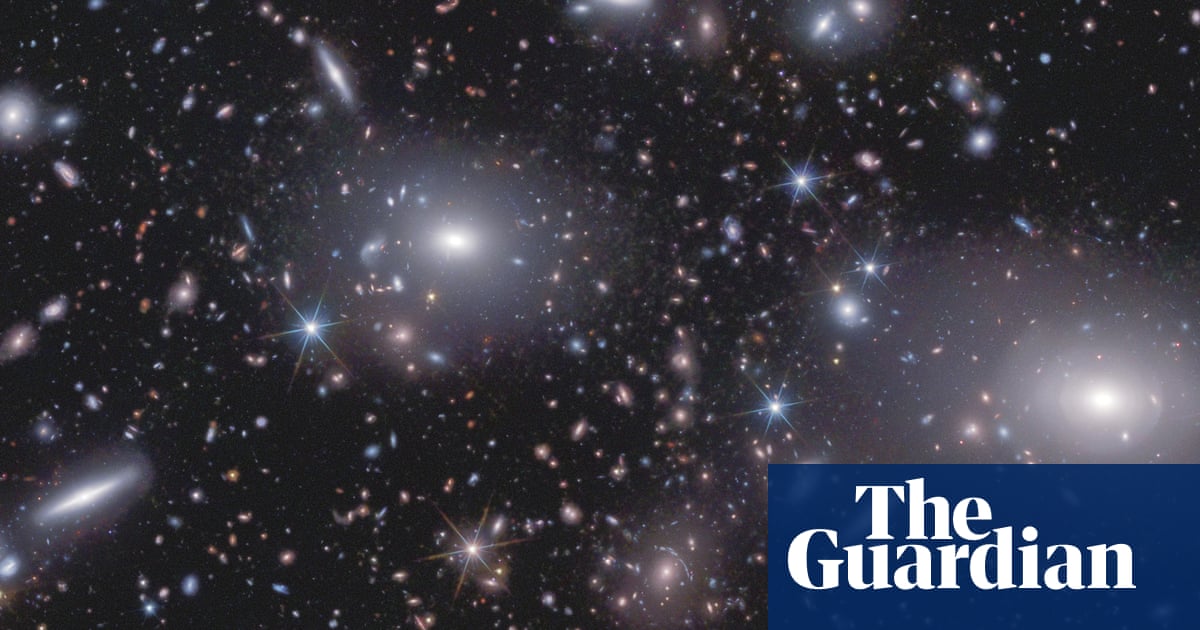
A mission to create the largest ever 3D map of the universe has revealed more than 900m galaxies in its first major data release together with about 15,000 potential cases of a phenomenon that could help unlock the secrets of the “dark universe”.Launched in July 2023, the European Space Agency’s Euclid mission promised to create the largest cosmic map ever made, encompassing a third of the sky and more than 10bn years of cosmic history.The goal is to shed light on two of the biggest mysteries in the universe: the nature of dark energy and dark matter. These are thought to make up about 70% and 25% of the universe respectively.Prof Andy Taylor, of the University of Edinburgh, who leads the UK science ground segment for the mission, said while there were bigger surveys, none had the detail and the information content of Euclid.
By contrast the Hubble telescope has produced images of incredible resolution, but does not cover as large an area of the sky.“The technological leap that’s Euclid is that we can keep that high resolution, but now we can basically map huge volumes of the sky, huge volumes of the universe,” Taylor said.The Euclid mission is intended to create the largest ever 3D map of the universe. Photograph: Esa/Euclid/Euclid Consortium/Nasa; Esa/Gaia/DPAC; Esa/Planck Collaboration, CC BY-SA 3.0 IGONow, the first major Euclid data release has landed, offering researchers an unprecedented view of the cosmos. “It’s the biggest high-resolution image of the universe we’ve ever had,” Taylor said.Covering about 14% of the total area of sky that will be mapped by Euclid, the newly released data captures over 900m galaxies as well more than 60m potential quasars: blazing objects at the centre of distant galaxies, powered by supermassive black holes.It also includes a tranche of candidates for what was previously considered a rare phenomenon: strong gravitational lensing.
This is a magnification effect that occurs when one galaxy, often embedded in a galaxy cluster, sits in front of another, distant galaxy.As Taylor notes, Einstein predicted the gravitational influence of the foreground galaxy would distort space-time, bending the light from the background galaxy and creating the appearance of bright arcs or rings. Crucially, the effect is significantly boosted by the presence of dark matter, which increases the mass and hence gravitational influence of a galaxy.Taylor said that by studying strong gravitational lensing, scientists may be able to rule out different theories on the nature of dark matter.
That is because the lensing is influenced by how this mysterious substance is distributed in a galaxy – that itself depends on its properties.Abell 3128, a cluster of hundreds of galaxies lying about 800m light-years away from Earth, is seen in this image captured by the European Space Agency’s Euclid space telescope. Photograph: Esa/Euclid/Euclid Consortium/Nasa/ReutersStephen Serjeant, a professor of astronomy at the Open University, agreed. “With strong gravitational lensing, you find out how the dark matter is clumping and that’s very diagnostic of the type of matter that it is, because different types of matter can clump in very different ways,” he said.“So if you’re looking for where the next breakthrough will be in the properties of dark matter and what dark matter actually is, there’s a good chance – I can’t say it’s certain – but there’s a good chance it might come from strong gravitational lensing.”Taylor noted that while experts previously knew of about 1,000 cases of strong gravitational lensing, the Euclid data contains about 15,000 probable cases, with an estimated 170,000 expected to be discovered by the end of the mission.A further release of data was expected to land next summer, Taylor added, which will include results on both the distribution of galaxies as well as weak gravitational lensing – subtle distortions in distant objects by dark matter in the foreground.“We can use that pattern of distortions to actually make a map of where all the dark matter is in the universe,” said Taylor, adding that scientists could then work out its statistical properties and compare the results with different theories. “Depending on the type of dark matter, the type of dark energy, we’re expecting to see slightly different patterns on the sky.”And with Euclid generating ever-more data, Taylor noted there was plenty to explore.“It’s opening up that high resolution of the whole sky, the whole universe.
So it just means there are plenty of objects that we’ll never have seen before, plenty of research phenomena,” he said. “No human eyeball is able to look at all of the Euclid data any more. It’s now too big.”