Top Stories
He used AI to test if a weed could help crops grow. Class 11 student wins Rs 4.1 lakh
From late-night experiments to international recognition Grade 11 student Rudra Patel has made his mark in scientific research His machine learning-based study on using invasive Lantana camara extracts as potential crop growth boosters won him a Gold Medal and two other major honours at Eskom Expo 2026
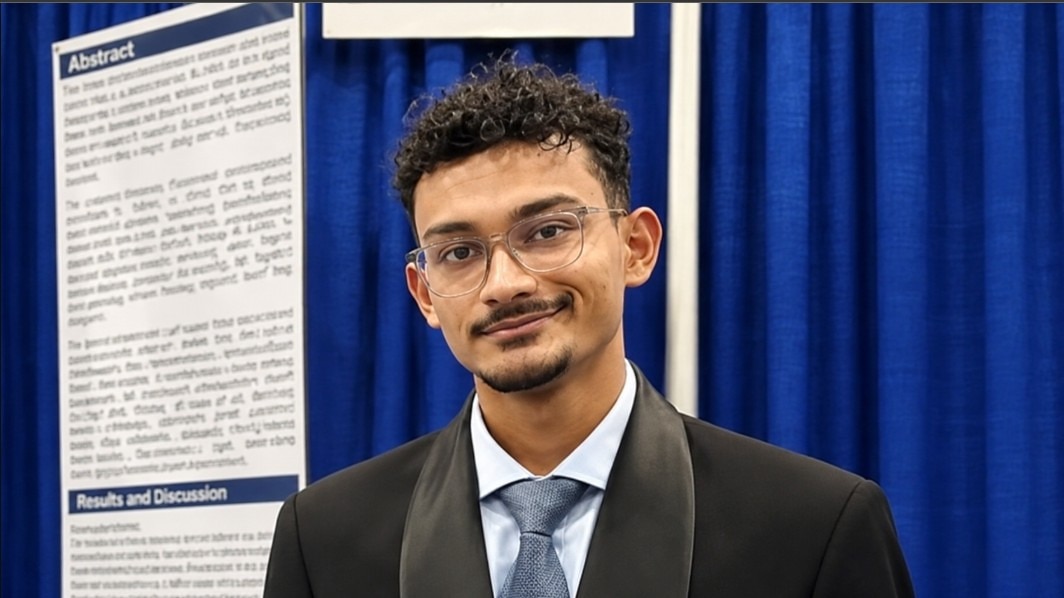
From late-night experiments to international recognition, Grade 11 student Rudra Patel has made his mark in scientific research. His machine learning-based study on using invasive Lantana camara extracts as potential crop growth boosters won him a Gold Medal and two other major honours at Eskom Expo 2026.He used AI to explore if an invasive weed could help crops grow, wins Rs 4.1 lakh At a time when young researchers are exploring innovative solutions to environmental challenges, Grade 11 student Rudra Patel has taken an unusual approach.
He used machine learning to investigate whether an invasive plant threatening local ecosystems could have potential applications in agriculture.Patel's research earned him three major honours at the 46th Eskom Expo for Young Scientists International Science Fair 2026. A student at the University of Johannesburg (UJ) Academy Maths, Science and ICT School of Specialisation, he won a Gold Medal, the Top Senior Scientist Award and the CambriLearn Built For How You Think Award.
The Top Senior Scientist Award carried a cash prize of R75,000 (approximately Rs 4.1 lakh), while the CambriLearn award came with a laptop.Titled 'Machine Learning Optimisation of Invasive Alien Plant Extracts as Sustainable Biostimulants for Crop Growth', the project examined whether extracts from Lantana camara, an invasive alien plant, could help promote wheat seedling growthHOW AN INVASIVE WEED BECAME THE FOCUS OF HIS RESEARCHPatel initially planned to study another invasive plant but struggled to obtain enough material for laboratory experiments as the species had largely been eradicated. He eventually turned to Lantana camara, a more accessible invasive species, to explore whether its extracts could be used as biostimulants to support plant growth.
His research also had an environmental dimension: finding productive uses for invasive vegetation that threatens local ecosystems. Young scientist celebrates his big win at the Eskom Expo International Science Fair 2026 alongside award presenters.
To test the idea, Patel developed machine-learning models to predict how different concentrations of Lantana camara extracts might affect wheat seedlings. He then conducted laboratory experiments to compare the predictions with actual plant responses.
The results revealed that while the models performed well on familiar datasets, their predictions became less reliable under independent experimental conditions. This highlighted that machine learning cannot yet replace laboratory testing when predicting complex plant responses.The research is still at an early stage, with further standardised experiments needed to establish its practical agricultural applications.LATE NIGHTS, INTERNATIONAL EXPOSURE AND A LESSON IN TIME MANAGEMENTWinning an international science fair was no easy journey for Patel.
He developed the project with his mentor, Ms Lindiwe Maphalla, in January, while balancing regular classes, examinations and other academic responsibilities. However, procrastination delayed much of the initial work until shortly before his District Expo.In May 2026, he travelled to the US to represent South Africa at the Regeneron International Science and Engineering Fair (ISEF), alongside two other young scientists from the Eskom Expo.On returning, he still had to complete computational modelling, laboratory experiments and his final research report, while preparing for the Regional Science Fair and June examinations.
The demanding schedule meant late nights and limited time with friends, and he admitted considering giving up several times.Support from his mentor, friends and family helped him persevere. The experience also taught him to manage his time better and balance competing responsibilities.By the time he was selected for the International Science Fair, Patel had learnt to plan his schedule more effectively.
He also developed valuable skills in reading academic papers, interpreting complex information, maintaining concentration and managing long study sessions. He believes these lessons will benefit his future studies, whether or not he pursues research.FROM ENGINEERING TO BIOMEDICAL RESEARCH: WHAT LIES AHEAD?Patel believes his research could eventually help scientists screen natural biostimulants, find productive uses for invasive plant biomass and explore more sustainable agricultural practices.
With further validation, such approaches could also contribute to discussions about food security and efficient resource use.His interests extend beyond agriculture to biomedical research, particularly xenotransplantation, which involves transplanting organs or tissues between different species.The award has also broadened his academic ambitions. While he initially planned to study mechanical engineering before specialising in aerospace engineering, he is now considering biomedical or chemical engineering, followed by postgraduate studies in computational microbiology.Despite winning R75,000, Patel has no plans for extravagant purchases.
He intends to invest the prize money and save it for future needs, particularly university education.Away from academics, the Grade 11 student enjoys crocheting and has made a life-sized emperor penguin and a Snorlax plushie at one-third of its original scale. He has also recently taken up baking and enjoys watching anime.
His favourite way to spend free time, however, is much simpler: sleeping.A YOUNG RESEARCHER WITH BIGGER QUESTIONSAt a time when machine learning is finding applications across scientific disciplines, Patel's project offers an important reminder that technology and laboratory research need to work together.His experiment has not yet established that Lantana camara can improve crop yields, but it has raised interesting questions about invasive plant resources, computational biology and sustainable agriculture.For a Grade 11 student, the recognition is a significant milestone. More importantly, his willingness to question his own model's predictions and explore new possibilities reflects the curiosity and scientific thinking that young research competitions seek to encourage.- Ends