Top Stories
Arctic polar vortex breaks down early: Will India's winters be affected?
A November disruption high above the Arctic could change the atmospheric circulation in the weeks ahead with possible implications for India's winter
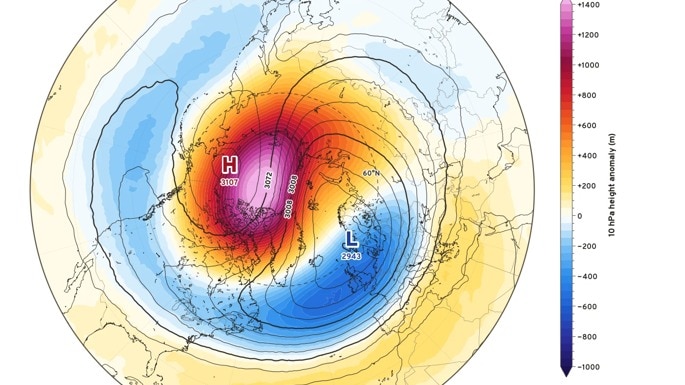
A November disruption high above the Arctic could change the atmospheric circulation in the weeks ahead, with possible implications for India's winter.A graphical representation of the polar vortex. India's winter weather could come under the influence of a development thousands of kilometres away, after strong winds surrounding the Arctic weakened and briefly reversed direction on November 11.The disruption of the Arctic polar vortex has raised questions about how winter weather could unfold across the Northern Hemisphere, including parts of Asia.The event is unusual because such disruptions generally occur in January or February, but this time, the reversal happened in mid-November, weeks earlier than previously recorded.
The polar vortex was unusually disrupted on November 11. Data show that winds about 30 km above the Arctic, which normally blow from west to east at around 28 metres per second, weakened and briefly reversed to blow in the opposite direction at around 2 metres per second.
Temperatures at this height were also around 10 degrees Celsius above the November 11 average.WHAT IS THE ARCTIC POLAR VORTEX?The polar vortex is a large circulation of strong winds that forms high above the Arctic during the Northern Hemisphere's winter. It develops in the stratosphere, the atmospheric layer above where everyday weather takes place.
These winds generally surround extremely cold air over the North Pole, helping keep it confined to the Arctic. A graphic illustrating the disruption in the polar vortex winds.
However, waves of air rising from lower atmospheric levels can disturb this circulation. The winds may weaken, the vortex can stretch or split, and temperatures high above the pole can rise sharply.This phenomenon is known as sudden stratospheric warming.
A major event is identified when the average winds at a particular level of the stratosphere reverse direction.COULD IT AFFECT INDIA'S WINTER?A weakened polar vortex can influence the jet stream, a fast-moving band of winds that steers weather systems across the Northern Hemisphere.When a disruption travels down through the atmosphere, the jet stream can become more wavy, increasing the possibility of cold Arctic air moving south into parts of North America, Europe and Asia. People warm themselves on a cold morning, in Srinagar, India.
These changes take time. It can take several weeks for the effects to reach the lower atmosphere, where everyday weather takes place.For India, this could influence larger winter circulation patterns, temperatures and the movement of weather systems.
However, a polar vortex disruption does not automatically mean a colder winter or a cold wave.WHY IS THIS EVENT SO UNUSUAL?Professor Andrew Charlton-Perez of the University of Reading said observations dating back to the 1940s had not recorded a disruption this early. Previous early events occurred in late November.The November 11 reversal lasted only one day in the available observations, and scientists are monitoring whether the weakening persists.Researchers are also examining whether the ongoing strong El Nino, marked by unusually warm waters in the tropical Pacific, could have influenced the event.
However, a direct connection has not been established.Whether this disruption changes India's winter weather will depend on how the polar vortex evolves and whether its effects reach the lower atmosphere.- Ends